












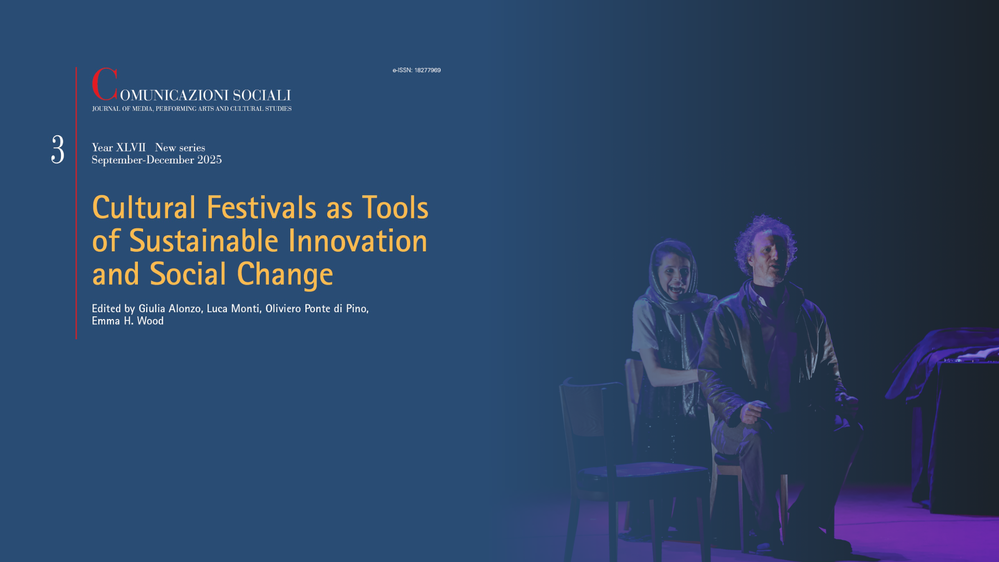
The scientific journal Comunicazioni Sociali of the Catholic University of Milan has published a scholarly article recognizing the Prishtina International Theatre Festival (PITF), organized by AAB College, as an important contributor to Kosovo’s international image. The article appears in a special issue dedicated to cultural festivals worldwide.
In the article titled “Theatre Festivals as Instruments of Cultural Diplomacy and Intercultural Communication,” PITF is assessed as an exceptional contributor to Kosovo’s cultural connection with the world. The publication emphasizes that PITF not only democratizes access to and perceptions of theatre in Kosovo, but also inspires international artists who, upon returning to their home countries, often act as cultural ambassadors of Kosovo.
Alongside AAB’s festival, the special issue features globally renowned cultural events such as the Sanremo Festival, Locarno Film Festival, San Sebastián Film Festival, and the Sitges – Catalonian International Fantastic Film Festival, placing PITF within a highly distinguished international context.
In the thematic issue titled “Cultural Festivals as Tools of Sustainable Innovation and Social Change,” the journal underlines the multifaceted role of theatre festivals in enabling countries to communicate values, build a positive international image, and promote intercultural dialogue through artistic expression and shared experiences.
While acknowledging other festivals held in Kosovo, including major music events, the analysis focuses exclusively on the Prishtina International Theatre Festival (PITF). The journal highlights that PITF has been organized continuously for eight years and represents the only traditional theatre festival of its kind in the Balkans. According to the article, the festival follows the guiding principle of President John F. Kennedy’s motto: “Ask not what your country can do for you—ask what you can do for your country.” In this spirit, PITF was conceived as a cultural instrument to promote Kosovo internationally, particularly at a time when the country faced challenges in global visibility as a newly established state.
Through an analysis of feedback from international artists and local audiences, the journal identifies a mutual impact generated by the festival. The PITF experience, the article concludes, has helped participants develop new cultural sensitivities and challenge pre-existing stereotypes, reinforcing theatre as a powerful form of cultural diplomacy.
The journal concludes that PITF functions not merely as an artistic gathering, but as a strategic instrument of cultural diplomacy and international visibility for Kosovo. By facilitating direct engagement between local audiences and international performers, the festival fosters cultural openness, empathy, and contributes to reshaping Kosovo’s image as a modern, tolerant society integrated into global cultural currents.
Comunicazioni Sociali, founded in 1966, is published by the Catholic University of Milan, recognized as the largest private university in Europe, with approximately 41,000 students.
The full article is available via the journal’s official publication.