











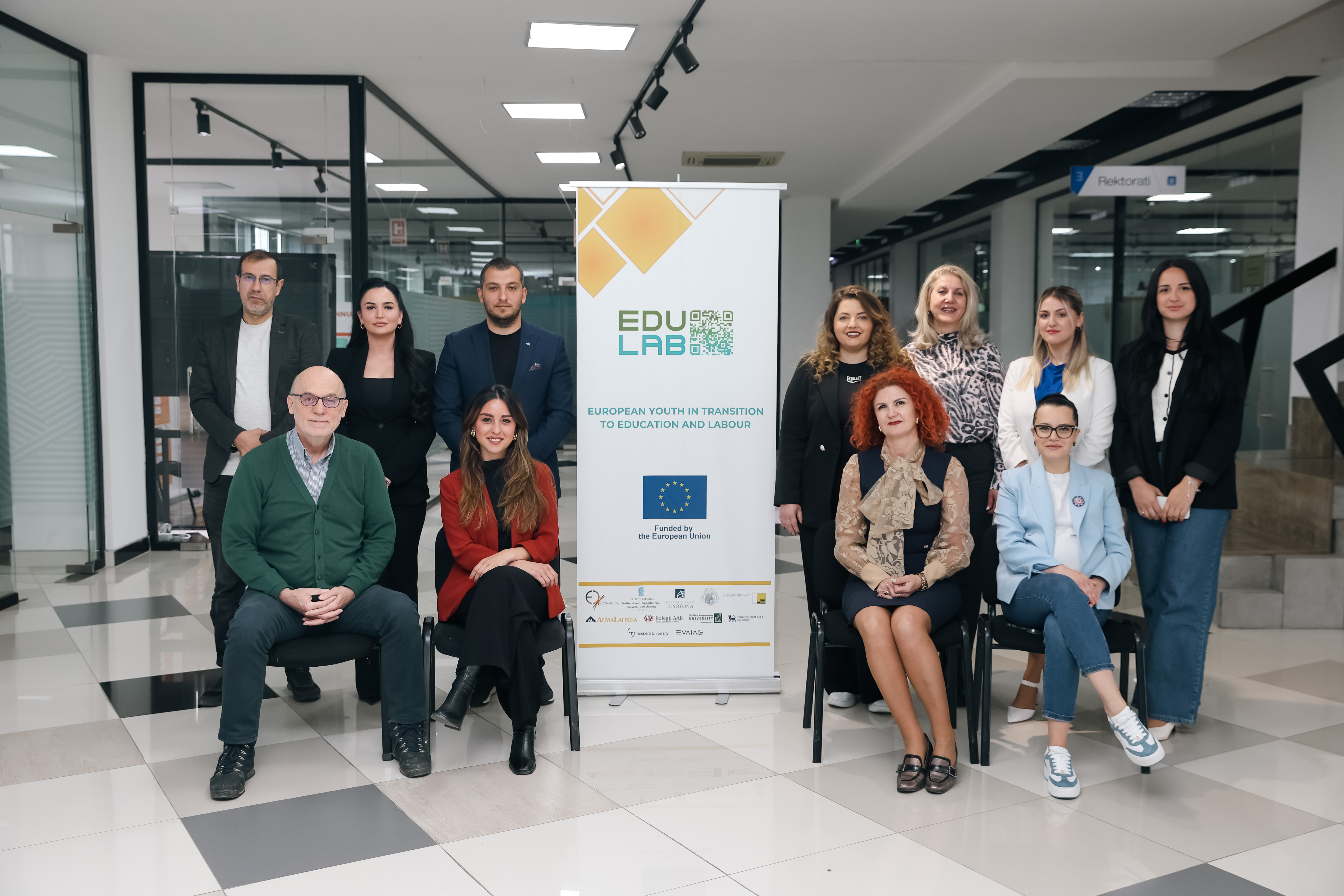
AAB College has secured a strong academic presence at ECER 2026 through the acceptance of
one symposium and three individual scientific papers, demonstrating the institution’s active role
in advancing research on youth transitions, education systems, and labor market dynamics
within the EDU-LAB Horizon Europe Project.
The accepted symposium, titled “Governing European Youth Transitions Through Education and
into the Labour Market: Policy Challenges and Early Evidence from the EDU-LAB Horizon Europe
Project,” is led by Xhavit Rexhaj of AAB College, with Petri Nokelainen from Tampere University
serving as discussant. The symposium includes four contributions from different countries,
addressing structural, policy, and socio-economic dimensions of youth transitions in Europe.
AAB College is directly represented in the symposium through the contribution of Arbëresha
Qerimi, co-authored with Xhavit Rexhaj, Fidan Qerimi, and Gresa Shaqiri. Their paper, “Socio-
Economic Determinants and the Impact of Parental Investments on Children’s Educational
Performance: A Microeconomic Study in Kosovo,” provides an empirical analysis focusing on the
impact of family-related factors on children’s educational performance in Kosovo. Other
contributions to the symposium include Theodor Leiber from Evaluation Agency Baden-
Württemberg, Alexander Chvorostov from Economica Research Institute, and Sini Teräsahde.
Through its coordinating role and scientific contribution, AAB College holds a central position in
this symposium.
In addition to the symposium, AAB College staff are prominently involved in two accepted
individual papers. The first, “Educational Aspirations and Institutional Realities: An Analysis of
Alignment and Mismatch in Youth Pathways,” is authored by Arbërore Bicaj, Erëza Mehmeti,
Gresa Shaqiri, Jeton Brajshori, and Etleva Namligjiu, and critically examines the relationship
between young people’s educational aspirations and the institutional constraints that shape
their realization.
The second paper, “Social and Institutional Factors Affecting the Lower to Upper Secondary
Education Transition in Kosovo,” authored by Arta Musollaj, Erëza Mehmeti, Gresa Shaqiri,
Vrullim Buja, and Flaka Jonuzi, explores the interplay between social and institutional factors in
shaping the transition from lower to upper secondary education in Kosovo.
Overall, these contributions demonstrate AAB College’s strong engagement in international
research collaborations and highlight the active role of its academic staff in producing
empirically grounded knowledge with relevance for policymaking at the European level.