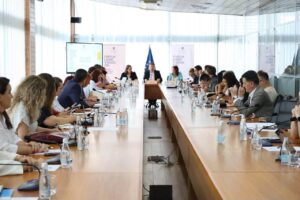










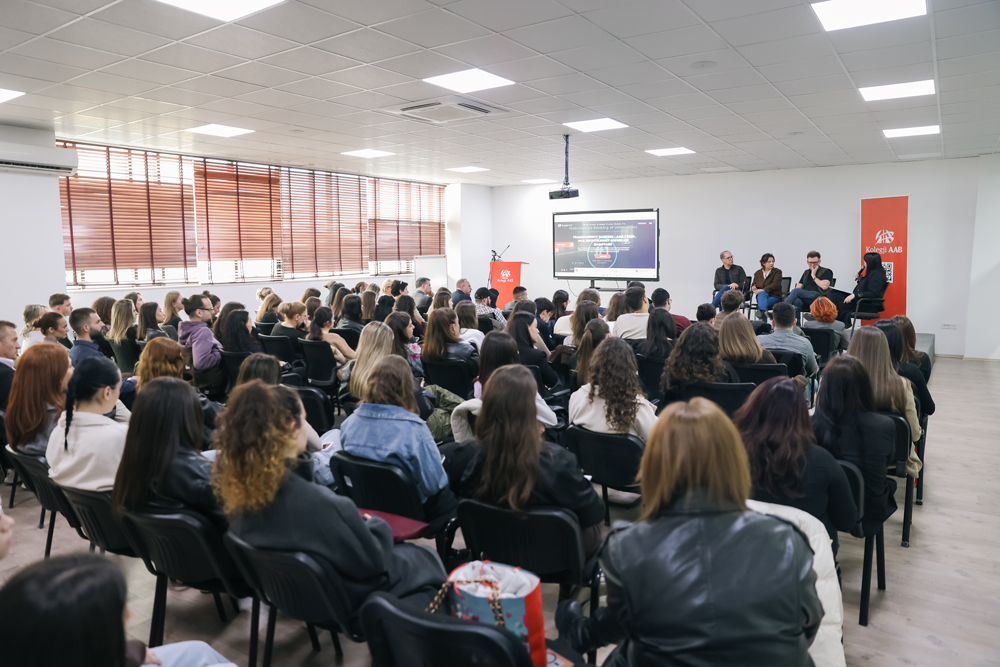
The Faculty of Psychology at AAB College organized the international event “Information, Trauma and Human Psychology,” moderated by Professor Donika Shahini-Lami. The event was held with the participation of international diplomats and over 100 local and international students, including students from MCC – Transylvania, Romania.
The event opened with welcoming remarks from the Rector of AAB College, Blerim Olluri, who emphasized the importance of documenting historical truth and the role of academic institutions in preserving collective memory.
He also acknowledged the contribution of professionals who reported on and documented the war in Kosovo, highlighting the engagement of Prof. Donika Shahini-Lami, who worked as a journalist during the conflict.
The Dean of the Faculty of Psychology, Arvesa Studenica, spoke about the need for both professional
and societal approaches to addressing psychological trauma, emphasizing that the consequences of war
are not only physical but also deeply psychological.
The event included two discussion panels. The first panel, titled “Information During War and the Psychological Impact of Testimony,” brought together journalists and international professionals. Panelists included veteran journalist Julius Strauss, Donald Harding, producer of the documentary Return to Kosovo, and Leman Kamberi Muriqi, who served as an interpreter for international journalists during the war and as the executive producer of the documentary.
The discussions focused on experiences of reporting from conflict zones, the responsibility of the media, and the psychological burden of bearing witness to the truth. The panel was moderated by Prof. Donika Shahini-Lami.
As part of the event, the documentary “Return to Kosovo” was also screened. The film tells the story of journalist Julius Strauss and Besnik Deliu, a survivor of the Upper Abri massacre, portraying their meeting during the war and their reunion more than two decades later, with a focus on historical memory and the processes of coping with trauma.
The second panel, titled “Trauma, Memory and Paths of Healing,” was led by Prof. Arlinda Gashi and included direct testimonies from war survivors. Panelists included Besnik Deliu and Arlinda Deliu (Upper Abri), as well as Leutrim Caraku (Poklek), who shared their experiences regarding the psychological consequences of war and the healing process. The discussions highlighted the importance of documenting the truth and preserving collective memory for future generations.
This event reaffirmed the importance of academic engagement with trauma, historical memory, and the role of information in supporting both societal and individual healing processes.