
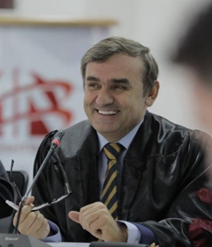
Lulzim Tafa was born on February 2, 1970, in Lipjan, Kosovo. He completed his undergraduate and master’s studies at the Faculty of Law, University of Prishtina, and his doctoral studies at the Faculty of Law, University of Sarajevo. He is a university professor. He has worked at universities both inside and outside Kosovo. From 2012 to 2020 he served as Rector of AAB College.
He published his first poems while a secondary-school student and his first book as a university student. He is the recipient of many prestigious international literary prizes such as the “Mihai Eminescu”- Romania “Radovan Zogović”- Montenegro, “Alexander the Great”- Greece, and “Pablo Neruda”- Italy among others, as well as national awards including the First Prize at the Poetry Meeting in Gjakova and the “Azem Shkreli” prize in Peja, and the nationwide First Prize “At Gjergj Fishta,” in Lezhë, Republic of Albania. He is also the holder of numerous national and international decorations and honors, such as the “Presidential Medal of Merits” awarded by the President of the Republic of Kosovo, the decoration “Yuri the Victorious” from the Holy Patriarch of Ukraine, and the decoration “Officer of the National Order of Letters and Arts” from the President of the French Republic, among others.
His poems have been translated into many world languages such as English, German, Italian, Serbian, Croatian, French, Bosnian, Montenegrin, Turkish, Greek, Romanian, Romani, Swedish, Arabic, Macedonian, Russian, Hungarian, Slovenian, Ukrainian, etc. and have been included in several anthologies.
Lulzim Tafa is a full member of the European Academy of Sciences and Arts, a full member of the Academy of Arts and Literature in France, an external member of the Academy of Sciences of Albania and the Bosnian Academy, among others, and he has been awarded the title “Doctor Honoris Causa” by several prestigious universities worldwide.
The war and humanitarian catastrophe in Kosovo in 1999 destroyed his personal library together with more than 300 poems in manuscript. Lulzim Tafa is also an activist for human and animal rights. He is noted for managerial experience in higher education, media, insurance, and the banking sector.
He is one of the best-known and most translated poets of Albanian literature in the world.
Books Published in Albanian
Books with Selected Poems
Books Published in Foreign Languages
“Lulzim Tafa’s poetry clashes at times on our walls where smile has lost its sense and we keep following its traces in vain. God knows what is going to happen to that smile that is relentlessly to get hold on us, as we are continuously losing the ground under our feet. This poet is distinguished by his intellectual courage as well as the manner of articulation differentiating him from other Albanian poets, where poets often lose their direction and get trapped in words, thus making this poet one of the most interesting poets our literature has today.”
(Ali Podrimja – Kosovo)
“Lulzim Tafa brings to the poetic experience of Kosovo and contemporary Albanian literature a distinctive, postmodern, meticulous spirit – from parody to quakes of the traditional that are equally important to all literatures that have reached maturity. Lulzim Tafa is a poet who is not afraid of anything, his “battlefield” is the language, and as we know, poets are unbeatable … the poet, Lulzim Tafa is truly a bold, talented, but at the same time disinclined to folkloric mythomania which always attacks the poems of some Balkan peoples. As for Tafa, just as for all great poets, poetry is “the miracle of the world and the power of gods” in face of which everything sinks to oblivion.”
(Jevrem Brkovic – Montenegro, one of the most popular writers in Montenegro)
Lulzim Tafa is a well-known poet from Kosovo, whose poetry is read all over the world. In the book ‘Unusual Prayer’, readers are introduced to an “unusual poet” who is now a well-known name in poetry not only in Europe, but also beyond. Tafa is one of the main representatives of postmodern poetry in Europe today, a special poet who writes beautifully. As soon as you read just a few lines, you come across an unknown world and find yourself in an extremely beautiful universe. After reading you will be richer and with an unforgettable experience.
(Atila Balazs – Hungary)
“The happiest poetic moments of Lulzim Tafa happen only when times and plans get confused and intersected, when the poet sings to the apple tree rooted deep in his memories that has survived the horrors of the destructive war together with the poet. When reading this Kosovo Albanian poet, one gets a feeling of reading Jacques Prevert”
(Abdulla Sidran, Sarajevo – Bosnia and Herzegovina)
“The verses of the poet from Kosovo, Lulzim Tafa are emotions as sharp as a sword, they are harsh but brilliant. This poet fascinates both, when singing to love and when singing to freedom”
(Daniel Marian, Romania)
“Lulzim Tafa’s balance between form and substance has not been disturbed, while symbolism, the varieties of meanings, cannot be said to be lacking. The author seeks to speak to the universe created through the identity embedded in verses, configuring it without pressure, without insisting in expression, and free of any poetic background and constraints, but very often with well-targeted warning nuances carved in memory”
(Marius Chelaru, Romania)
“From the moment of the publication of his first book of poems, Lulzim Tafa has masterfully unmasked the Serbian invasion and genocide against the people of Kosovo, the violence exercised on Kosovo’s culture, religion and literature. This literature – including Lulzim Tafa’s style – is an original form of expression that has enchanted many scholars and anthropologists. Lulzim Tafa, through his outstanding poetry is regenerating the sleepy history of an ancient people”
(Peter Tase, Albania, USA)
“For Lulzim Tafa, the world and the connections, the world and individual contacts make up the necessary boiling material, along with his courage for creativity. It is due to this reason that his poetry is not conveyed but it is experienced, and everything begins from a case, a motivation and a cause. The author is thus supplied by order with a non-stop program of the world, and on his shelves, one can find everything. He is considered an “irreparable” poet, lured by the world he lives in, which he transposes with special affection in his poetry. This is, at the same time, his faithful profession, where the poet never puts a “full stop” to his verse”
(Monika Muresan, Romania, Literary Scholar)
“In his poetry, the poet Lulzim Tafa constantly endeavors to describe his two interconnected worlds: the inner world filled with memories, feelings and dreams, and the outside world, the real one (the truth). For this purpose, in the poetry of Lulzim Tafa two original and effective tools have been put in place to express the poetic substance: frames and “comparison of wars”
(Daniel Lion, Romania)
“Lulzim Tafa is an Albanian poet from Kosovo, whose style differs from other Balkan poets. His poetry intertwines the lyrics with the epic and the dramatics in equal dimensions. The author constructs the stylistic figures and poetic expressions, over the paths that can be considered as the boundary of the homeland of poetry, at least, with a step that breaks through the dream gate, beyond which the muses pour into their hive, the honey of the heavens of speech”
(Inger Lalander, Sweden)
“Tafa’s poems are a testament, engraved by nails and language (just as the great Greek poet Jergos Seferis engraved his poems) from life, from the land of Kosovo, but applying to all countries and peoples. In Lulzim Tafa’s poetry, the darkened freedom speaks, a powerful geyser pouring out from the poet’s heart. These poems are a call from the deep space where it lives, and which is iconic and archetypal at the same time. They are a faithful and safe guardian of iconic acts, conveyed by Tafa onto his time. This poet, the preacher of hope, carries the sun through the darkness of time. This is how I saw all this while reading his poetry. Such privileges and honors do not happen frequently. This introductory word of mine is a modest gift to Tafa, to his poetry and to the overall Albanian poetry, which, I’m sure it will be a great European and world discovery”
(Mirash Martinovic, Montenegro)
“Lulzim Tafa belongs to the vitalist, neo-romantic, exalted poets. He has proven to be a subtle psychological analyst, at times nourishing a persuasively sarcastic humor”
(Lucian Gruia, Romania)
“The poet, Lulzim Tafa writes in a sensitive way, from deep experience, sincerely, warmly … His thoughtfulness and sensible attitude is transformed and streamed into almost every poem of the book, where the two main female protagonists Teuta and Ajkuna (Una) represent the main pillar, like fire and flames, but also breathing, longing, dreams, pleasure, memories … Tafa transforms dreams. He dresses and undresses metaphors, recognizes and immortalizes them, he weighs and measures the time and space, the world and the century … He cares for and observes the path of light, always observing the dark side, balancing it as a balancing instrument and almost at the same time between the life of a dog and a man the same, enjoying the fruits, but also the curse of the creation and the craft of the writer”
(Hristo Petrevski, North Macedonia)
“The poet Lulzim Tafa possesses the talent to transfigure the reality into a special lyrical record, in the confessions of rain and shadow, of life and death, of the lost love, but especially of the hope that the pain will be altered through love and faith in the morning of the existence of another future. Love is one of the pillars of author’s poetry, but also life and death, love having the strength to turn the time into echoes of filling in the desert in the hearts of some, an oasis of fruit and permanent dreaming. Lulzim Tafa possesses the knowledge to understand the secrecy of the dew drops in the tranquility before the dawn, as well as the bell sounds warning of the upcoming events.”
(Ion Deaconescu, Poet and researcher from Romania)
“Lulzim Tafa’s poetry sounds like an intelligent conversation with the reader. To put it bluntly, it is a poetry that captivates you with the emotion it transmits, as well as its linguistic expression. It’s easy to read but difficult to erase from your memory.”
(Agim Vinca, Kosovo University Professor, poet)
“The poetic asceticism for the untold, collective guilt and suffering, seen in the context of the intimate epic, is one of the most highlighted values of Lulëzim Tafa’s poetry in the book “A few more words to say.” The irony and paradox for exhibitors, disciplined and linguistically rationalized, complement the collective experience, which seems to be set in a mysterious harmony. This fragility is not the truth, but the passion for the truth, which is intended to be said in two words, but in fact, it is not said, or will ever be told except through poetic art, yes, as in the hushed but alarming poetry of Tafa.”
(Ibrahim Berisha – Kosovo)
“In the verses of Lulzim Tafa, the fulfillment of the aspired ideal is reached: to enjoy the beauty. Hence, the structuring of sensitivity, ideas, motives, topics, etc., as if they are a combination of visions in the prelude of a poetic anxiety, in which the poetic expression system relies on confronting the real with the unreal world, explaining the essence of life through the essence of poetry.”
(Sali Bashota – Kosovo)
“Tafa’s lyrics are distinguished by the extreme economizing of words, through the language play, without which there is no literature – it tells a lot and conveys messages of all times. His poetry has unbelievable abilities to communicate with the contemporary reader. We are convinced that it will communicate with both Albanian and foreign readers.”
(Salajdin Salihu – North Macedonia)
“A rebellious spirit, witty irony reaching sarcasm, the natural outbursts we encounter rarely in Albanian poetry are the traits that permeate the poetry of Lulzim Tafa, who manages to bring down the boundaries between epic and lyrics, meaning that at times it shows a lyrical epic and especially an epical lyric, in what can be called love poetry.”
(Rrahman Paçarizi – Kosovo)
“Lulzim Tafa occasionally constructs stylistic figures and interesting poetic expressions in the context of a number of variations that are related to his option. Lulzim Tafa provides us with innovation and quality, while his book enriches the foreign reader with legendary characters and current ideas. He presents a healthy lyrical spirit of fresh air in the content of literature. Characters, places and events are followed by the reader with special curiosity.”
(Laura Rushani, North Macedonia, Romania)
“Poetic creation of Lulzim Tafa is so powerful and so deep and at the same time a shocking phenomenon in the modern Albanian literature. His verses are overwhelmed by a profoundly humanistic philosophy and are overly stinging against the behavior of those who benefited at this time of commotion. This time where commotion, intrigue, exploitation, selfishness, ignorance, and all other evils prevail, the poet calls on the “holy rain” to cleanse the conscience and announces the birth of the era of democracy and respect for human rights”
(Ile Demiri, Kosovo)
“Lulzim Tafa creates an interesting poetry which witnesses the power of the personality. If anyone asks God for courage or power, God does not give him the courage or power, but the opportunity in which the person must discover whether he has courage and power. The enemy in his verses turns to God for help, but in vain, because God does not help the wicked but the victim.”
(Baki Imeri, North Macedonia, Romania)
“In this form of poetry, I have done the reading as if reading the reality of time. Thus, Tafa purposely emphasizes the idea of repeating the topics. In brief, this deliberate repetition is read as time or days of the week repeat themselves, but the events change.”
(Jeton Kelmendi, Kosovo)
“The meditative depths of Lulzim Tafa appear with verses in a multitude of colors with moods, sometimes like fresh-breeze aquarelle, and occasionally with gloomy monochrome metaphors. Lyrics and drama interact by countering each other. Meanwhile, the messages are laconically intertwined with masterful engraving.”
(Shyqri Nimani, Kosovo)
“Lulzim Tafa makes the art of the possible, politics an art of literature through poetry figures: allegory, irony, satire, metaphor, symbol, comparison, epithet, paradox etc., which he distributes, a little, in poetry titles and more in verse. But these are not the figures that make this poet interesting, nor do they end his discourse.”
(Berat Armagedoni, Kosovo Literary scholar)
“The lovers of poetry will find in the verses of Lulzim Tafa the realistic qualities of the modern lyric: above all: warmth, grief, melancholy, directness, criticism, melody … The rich and picturesque language also represents a creative quality of the poet whose emotionality and tenderness are also a quality, emotionality and mildness arising from sincere excitement and dreams, all in accordance with Dionysus’s joy and lamentation. Thus, the individuality connects to the collectivity, and the local to the universal, thus gaining the broadest aesthetic importance, the poetic vision, and the rich metaphor of the expression.”
(Milutin Djurickovic, Serbia)
“Lulzim Tafas’ poetry from the semiology point of view touches the heart: it is in the permanent mode of exploring, so it asks the same from the reader. In other words, even what looks like a love poem, it is not (necessarily) (only) love poetry. Tafa’s verses are obsessively nourished by the motives of blood, thus directing it to own experience of illogical madness of war but also reminding us how and how much the poetry can be universal, even when it points to a very concrete period of a tragic reality. Tafa’s poetry is a detailed reconstruction of that reality, disturbed reminiscence against the universal pamphlet. Each of his poems is an enigma of blood episodes of history, and which the reader unfolds to puts in place pieces of historically proven events.”
(Tina Laco, Bosnia and Herzegovina)
“Lulzim Tafa is the poet who leaves open the possibility of multifaceted interpretation. His selected style of writing implies that he does not impose himself to the reader. Rather, he leaves the reader to freely enjoy his poetry and then through the plurality of interpretation to judge in his own way.”
(Xhemajl Peci, Kosovo)
“Lulzim Tafa views the world as a blessed and eternal gift. He knows how to decipher the internal light of words. His words shed light, because they are the eternal light of the Albanian soul. Lulzim Tafa gives priority to the elegance of poetic discourse. The poet is the owner of spiritual experiences in the context of manifested feelings. The author surprises us with the depth of describing moments and experiences. His verses look like neo-Romanticist pearls of postmodernist values that do not overlook the stately gender of the classic variant. Occasionally, the poet’s revolt is provoked by the fierce and relentless manifestation of the capitalism of the jungle which stains the traditional, moral and normal values.”
(Lucian Gruia, Rumani)
Poet Lulzim Tafa is a delicate and sensitive lyricist, who writes about his environment, about life and intimate love, about the homeland and nature, about patriotism and the universe and other more or less common themes and motifs. As much as he is national and patriotic (“Teuta”, “Skenderbeu”), he is also humanist and cosmopolitan in solidarity and tolerance, showing undisguised love and loyalty not only for his own, but also for all other nations around.
(Bajram Haliti, Roma poet and researcher)
Lulzim Tafa is a poet who writes cleanly, simply and humanly. He almost perfectly uses figurative language and stylistic combinations, both literally and in a symbolic sense. He does not seek any modernity or avant-garde experiments in his work, but, as Tolstoy would say: “He loves only what is possible and accessible to the human mind, in the poetry of this poet – everything is in its place. Lulzim Tafa helps us understand the incomprehensible and love what hurts.
(Vladimir Alexandrovich, Russia)
I find myself reading the work of Lulzim Tafa and discovering his great talent in these very sad times, when Europe is torn apart by the Russia-Ukraine war and I am struck by his foresight from his verses on peace and war, literally mesmerized by the unique, innovative and unprecedented style of love verses. They are pleasant and subtle erotic references that show human passion, but there are also many compositions with allusions to death in the usual minuet between Eros and Thanatos. His poetry is a form of resistance, a form of testimony and protest.
(Claudia Piccinno, Itali)
The stoic poetry of Lulzim Tafa gives us an example of the path to follow in the trials of our destiny, which recalls the ancient truth of the hermetic body about the analogy between the heavenly and the earthly. Behind the curtains of illusion, an increasingly inconvenient stasis, we find a self that, while engulfed in the flow of everyday life, maintains the necessary distance to not dissolve in its waves.
(Dymytro Chystiak, Ukraine)
The general content of Lulzim Tafa’s poems is salvation from all kinds of socio-psychological-spiritual anomalies that occur in the world of the 21st century. The relationship between the world and the mental state of the image is embodied not by general landscapes, but by vivid, concrete facts of life. Chaos and chaotic events, wars, conflicts, political games, incidents and massacres that prevail around the world, take deep content in his verses, being sometimes presented with ironic nuances, sometimes with harsh-realistic colors, the essence of the events are universalized and arise from the aspect of human truths.
(Elnara Akimova, Azerbaijan)
Lulzim Tafa is a poet who tries to summarize his life drama, portray and then unify it with the view of the world around us. His thoughts are clear and concise.
Precisely he makes it possible to establish a complete and almost perfect communication with the readers. From the beginning when it comes to the poetry of this poet, it is necessary to determine the aesthetic achievements and peculiarities of his lyrics.
(Jože Brenčič, Slovenia)
Lulzim Tafa in poetry does not take the role of a sage as some writers know how to assign themselves. He starts from a point. He starts simple; no dictionary; go a long way with just one of his world essentials. He reaches where he planned, but without the burden of the road, without the burdens of life. He enjoys the road and the events that come ahead of him. Tafa, with his creations, leads the way with poetic images in front of which the rest of us covet. We boldly covet it.
(Naime Beqiraj, Kosovo)
Lulzim Tafa’s poetry is a parable and a post-modern paradox, that highlights the reality that crashes with the traditional way of thinking (and poetry) as well. Tafa resemantizes the myth of Kronos with his laconic language and his own means of expression. Tafa doesn’t speak, instead he creates images that deliberately confuses them for the reader to rearrange them as in a mosaic ‘puzzle’, to make each word poetically a figure in itself, an event… Basically, Tafa’s poetry is the dividing line between mundane aesthetics and profane.
(Halil Matoshi, Kosovo)
When I read Lulzim Tafa’s poem for the first time, I was overwhelmed with an odd feeling of Rosemary’s life. His clear references to everyday life and furthermore his precise references to myths and symbols really caught my attention.
(Reza Hosseini – Iran)
Tafa’s poetry is the poetry of two poles that in themselves are opposites: on the one hand, it is the poetry of suffering and weakness. On the other hand, it is a poem of high morals and ideals, where the latter ultimately defeats the former. The author Tafa has the talent to tell a whole story and say a lot in just a few words.
(Ardit Mehmetaj, Kosovo)
Tafa’s verses have a condition to be read, they descend on flat fields, in unexposed alcoves, in steep mountains and in exposed social environments. Lulzim Tafa’s poetry apostrophizes various personifications, the tendencies that push the human mind to judge a normal path of society, the bastards sliding in the name of patriotism towards gluttony, the abominable gluttony. His poetry apostrophises various personifications, tendencies that push the human mind to judge a normal course of society, bastardizations slipping in the name of patriotism into gluttony, disgusting gluttony.
(Mergim Bekteshi, Kosovo)
Tafa’s poems are rich poems with a conglomeration of figures constructed through an imaginative “horizon”. The language that the author writes his poems shows the freedom of the poet in his lyrics, which allows the reader to give different interpretations to his poem, without limiting it. The lack of punctuation at the end of the verses makes this possible. Tafa’s poems are not built with a uniform rhythm, they consist of free form, which enables them to be read in one breath.
(Kreshnike Bruqi, Kosovo)
Poet Lulzim Tafa does not have ordinary poetry, nor is it complicated, rhymed, embellished, sentimental, mournful, washed out, or distant from the reader. Instead, he has poetry that has become his vocation, discovered and developed through poetic talent with sincere dedication to the verse and the queen poetry.
(Mustafë Xhemaili – Kosova)
For the poet Lulzim Tafa, there are no taboos or untouchable, forbidden things, no idols or models created era after era, but the cultivation of this kind of poetry leaves a message for fanatics of beliefs and volunteers of crowds; he preserves the element of surprise in every poem and cycle with other predecessors. He prefers short poetry and free verse, venturing where not everyone can go. He finds poetic imagery in the most ordinary events, but also in myths, treaties, and ancient biblical documents; he feels pain for the passing of his mother or the absence of ‘a window by the grave’; he employs irony, even to the point of sarcasm, with everyday life events.
(Çerçiz Loloçi -Albania)
Lulzim Tafa’s poetry represents a rich artistic universe, where the verses are filled with lyricism, irony, and revolt, creating an all-encompassing aesthetic dimension. With a unique and unique style, the poet unfolds deep spiritual feelings, intertwining symbols, antitheses, and metaphors to reflect the drama of the Albanian world and personal experiences. His poems are distinguished by chosen language, sensitivity, and meditative power, transcending time and space in an eternal communication with the reader. Tafa possesses the ability to transform war into peace and dreams into free art, leaving an permanent mark on both Albanian and universal literature.
(Violeta ALLMUÇA –Albania)
This poetry of Lulzim Tafa reveals a mature and distinctive voice in contemporary Albanian literature. His verses carry emotional depth, artistic coherence, and an authentic poetic identity that stands out in both form and substance. The work reflects a rare blend of originality, clarity of thought, and expressive force, placing Tafa among the most notable poetic voices of modern Albanian poetry.
(Besnik Mustafaj – Albania)